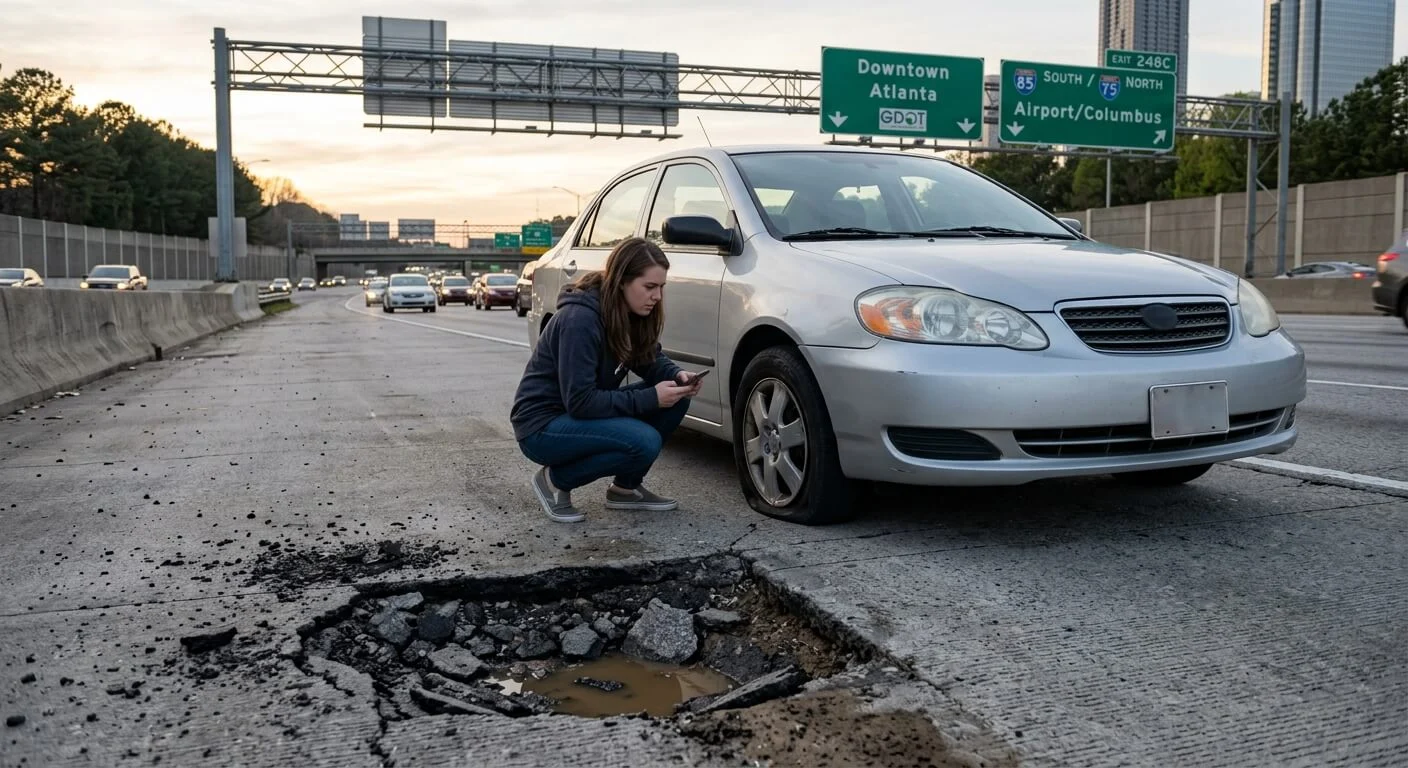
If you’ve driven in Atlanta for any length of time, you already know the roads here can be rough. Between the freeze-thaw cycles in winter, heavy rain, and constant construction traffic, Metro Atlanta’s streets and highways are full of potholes, and some of them are deep enough to do real damage. Hitting one at speed isn’t just jarring, it can throw off your alignment, damage a tire, bend a wheel, or worse, and leave you wondering whether your car is still safe to drive.
Here’s what to do immediately after hitting a pothole, what symptoms to watch for, and when it’s time to pull over and call a tow truck instead of continuing to drive.
What to Do Right After Hitting a Pothole
Don’t panic, but don’t ignore it either. The moment you hit a significant pothole, take a quick mental note of how the car feels. Does it pull to one side? Is there a new noise? Does the steering feel different? These first few seconds give you a lot of useful information.
Find a safe place to pull over. If the car feels off in any way (pulling, vibrating, making noise), get off the road as soon as it’s safe to do so. Pull into a parking lot or side street rather than stopping on a busy shoulder if you can. A quick check is always worth the few extra minutes.
Do a visual inspection. Once you’re safely stopped, walk around the car and look at all four tires. Check for visible damage. A flat or rapidly deflating tire is usually obvious. Look at the wheel rims too; even if the tire looks fine, a bent rim can cause problems at speed.
Check your tire pressure if you can. Some newer vehicles have a tire pressure monitoring system that will alert you on the dashboard. If yours doesn’t, and you have a gauge in the car, a quick check of all four tires takes less than two minutes and can tell you a lot.
Warning Signs That Something Is Wrong
Some pothole damage shows up immediately. Other damage is more subtle and becomes apparent once you start driving again. Watch for any of the following:
- Pulling to one side: almost always a sign of alignment damage or a tire issue
- Vibration in the steering wheel or through the seat: could be a bent wheel, damaged tire, or suspension problem
- Thumping or bumping noise while driving: often a sign of a flat or damaged tire
- Car sitting lower on one corner: could indicate a flat tire or a damaged suspension component
- Steering that feels loose or unresponsive: a more serious sign that suspension or steering components may have been affected
- Fluid leaking underneath the car: a hard pothole hit can sometimes crack or damage components that hold fluids
Is It Safe to Keep Driving? Do I Need to Call for Towing Services?
This depends entirely on what you’re experiencing. Here’s a rough guide:
You’re probably okay to drive carefully to a shop if:
- The car drives straight with no pulling
- There’s no unusual noise or vibration
- All tires look and feel normal
- No warning lights have come on
Pull over and call a tow truck if:
- A tire is flat or going flat: driving on a flat, even for a short distance, can destroy the tire and damage the wheel beyond repair
- The car pulls severely to one side and is hard to keep straight
- You hear a loud thumping, grinding, or scraping noise
- The steering feels significantly different than before the hit
- Fluid is leaking from underneath the car
- A warning light has come on, especially for tire pressure or stability control
The general rule is this: if there’s any doubt about whether the car is safe, it’s always better to have it towed to a shop than to risk a second, more serious breakdown further down the road, especially on a busy Atlanta highway.
Don’t Forget to Document It
If the pothole was on a city or county road, you may have grounds to file a claim with the City of Atlanta or the relevant county. Take photos of the pothole if it’s safe to do so, note the location, date, and time, and document any damage to your vehicle before it gets repaired. Whether or not a claim goes anywhere, having a record is always useful.
What Happens at the Shop
Again, diagnosing and repairing pothole damage is a job for your mechanic, not a towing company. What we can tell you is that the most common repairs after a significant pothole hit include wheel alignment, tire replacement, wheel balancing, and in more serious cases, suspension component replacement. Catching these issues early is almost always cheaper than letting them go.
Where Atlanta’s Potholes Show Up Most
Potholes open up fastest after heavy rain, when water gets under cracked pavement. You’ll often find them on older neighborhood streets, at the edges of lanes on busy roads like Piedmont Rd and Peachtree St, and in construction zones where lanes shift on I-285 and GA-400. Slow down on wet roads, and leave enough space to see the pavement ahead of the car in front of you.
Reporting a Pothole in Atlanta
Reporting a pothole helps get it fixed before it catches the next driver. City streets in Atlanta are reported through ATL311, by phone, online or in the ATL311 app. State routes like I-285, I-85, I-75 and GA-400 are maintained by the Georgia Department of Transportation (GDOT), which takes pothole reports through its website.
Can You Get Your Repair Costs Back?
In some cases you can file a damage claim with the city or the state for pothole damage. The rules and deadlines vary, so ask ATL311 or GDOT how their process works. Either way, keep your photos, the exact location, the date and time, and every repair receipt.
Pothole Damage and Your Car Insurance
If you have collision coverage, it may cover pothole damage to your car, minus your deductible. Every policy is different, so call your insurance company and ask before you get the repair done. Have your photos, the location and the repair estimate ready when you call.
Check Your Tires Again a Week Later
Some pothole damage shows up slowly. A tire can lose air over several days, or a small bulge can grow in the sidewall. A week after a hard hit, check the tire pressure and look at the sidewalls again. If the car starts pulling or vibrating, have the alignment and wheels checked.
When to Call a Tow Truck in Atlanta
If your tire is flat, your car is making serious noises, or you simply don’t feel safe driving it, calling a professional Atlanta towing company is the right move. Trying to drive on a damaged tire or a compromised suspension to avoid a tow bill can easily turn a few hundred dollars in repairs into a much larger problem, and it puts you and other drivers on the road at risk.
Hit a pothole on an Atlanta road and not sure if your car is safe to drive? A+ Quality Atlanta Towing Company is available day and night to get your vehicle off the road and to a shop safely. Call (470) 805-2240 for fast, reliable tow truck service and roadside assistance anywhere in Metro Atlanta.